

Suit sewing
Would you like to learn the special craft behind the Fanø costume? As a member of the Old Sønderho Association, you have the opportunity to participate in our annual costume sewing course, where tradition and craftsmanship go hand in hand.
Here you will learn how to sew the Fanø costume with respect for the old techniques and fine details. There is great interest in the course, and therefore there may be a waiting list. But you are always very welcome to sign up.
PRESERVING THE SUIT
- AND THE ART OF WEARING IT
From the Sønderhodag speech 1936:
"(…) I would like to recommend to the Foundation's Board of Directors that they keep a watchful eye to ensure that there are always people who can sew the Fanø costume and can fit the headgear correctly."
The Fanø scarf is one of the island’s most beautiful hallmarks, closely connected to traditional folk costumes and the island's maritime cultural history. The tradition dates back to the 18th and 19th centuries, when Fanø’s sailors travelled on long voyages to distant parts of the world. When they returned from journeys to, among other places, Asia, they brought home the finest silk scarves for their wives and daughters. Many of these came from China and India and soon became part of the local dress – a visible testament to Fanø’s encounter with the wider world. Today, the tradition lives on. Fanø scarves are still handwoven in India by skilled artisans in a village with proud weaving traditions. Before the work begins, the Danish weaver Margit Korshøj studies an original scarf from the collection of the Gamle Sønderho Foundation. She carefully documents the pattern, colours, materials, and weave density so that the Indian weavers can recreate the tradition with great precision. Creating a Fanø scarf is a slow and demanding process. Setting up the loom alone can take several days, as up to 30 silk threads per centimetre are often used. Sample pieces are woven first, a process that typically takes three to four months. Only then does the actual production begin, which takes another three to four months. Once the scarves are finally finished, they are washed, hemmed, labelled, pressed, and packed. Each scarf is unique. Small variations in the weave bear witness to the craftsmanship involved and highlight the difference from machine-made products. A Fanø scarf is therefore much more than a piece of fabric – it is the result of many months of dedicated work, a high level of expertise, and deep respect for tradition. The price reflects this long and meticulous process, and each scarf carries a story that connects Fanø with the rest of the world.
SEWING COURSE BY BIRTHE SIMONI

As part of its efforts to preserve and pass on the traditions of the Fanø costume, Fonden Gamle Sønderho offers sewing classes led by Birthe Simoni.
Birthe is a trained tailor with a background in pattern cutting. Around ten years ago, she began learning about the traditional craftsmanship of the Fanø costume from Jørgen Gram, who taught her the historic sewing techniques and cutting methods.
Over the following years, Birthe devoted herself to studying the design, sewing techniques and construction of Fanø costumes, working from the original patterns that Jørgen Gram had preserved.
In 2020, a sewing group was established under the auspices of Fonden Gamle Sønderho, allowing this knowledge and craftsmanship to be passed on to a new generation of costume makers.
Classes take place every Monday at Birthe's home in Sønderho, where participants learn to make Fanø costumes using traditional patterns and techniques. Please note that the classes are taught in Danish.
There is currently a waiting list for the classes, but anyone interested is very welcome to contact Birthe at simoni@post.tele.dk to have their name added to the list.
Participation is free of charge for members of Foreningen Gamle Sønderho.

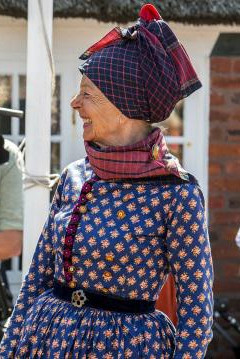
What suit can I sew?
There are many different types of Fanø suits, from the small-flowered everyday suit to the fine silk party suit. The choice of suit has an impact on both fabric, colors and details, just as edging, buttons and other decorations vary depending on the type and purpose of the suit.
If you are unsure about which suit you would like to sew, you can find inspiration and learn more about the different suits in our suit gallery .